

2026 Healthcare Security Outlook Report
Key trends shaping the shift to more comprehensive cybersecurity resilience in healthcare
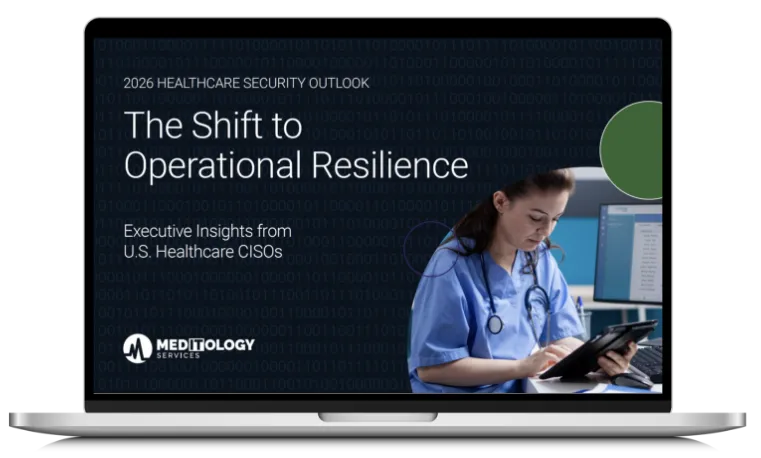
Healthcare cybersecurity has reached a critical turning point. The industry is no longer facing a gap in tooling; it is facing a gap in operationalization — the ability to translate massive volumes of security data into enterprise risk decisions that protect patient safety and care delivery.
Based on interviews conducted with cybersecurity leaders in early 2026, this report reveals an industry moving decisively away from “check-the-box” compliance toward measurable operational resilience.
What you’ll learn:
- Why resilience — not prevention — is now the primary measure of cybersecurity success
- How the Change Healthcare breach permanently transformed third-party risk management
- Why AI governance must come before AI deployment in clinical settings
- How organizations are consolidating security platforms to stretch constrained budgets
- What hallmarks separate emerging security programs from truly mature ones
“Compliance is table stakes, but managing the operational rigor to sustain it without burning out your team is the real challenge for 2026.”
— Healthcare CISO
“Every dollar we spend has to map back to risk reduction or operational protection.”
— Healthcare CISO
“Security has to support care delivery, not slow it down.”
— Healthcare CISO
EXECUTIVE BRIEF
Executive Brief
The Executive Brief introduces four macro shifts reshaping every investment decision, staffing plan, and board conversation in healthcare cybersecurity — grounded in real-world perspectives from security leaders at health systems, payers, and health technology companies.
PART 1
The Resilience Mandate: From Prevention to Care Continuity
The primary metric for cybersecurity success has shifted. Boards have stopped asking “Were we breached?” and started asking “Can we still deliver care?” — driven by a 63% year-over-year increase in healthcare breaches that has proven total prevention is an unrealistic goal. This section uncovers:
- Why resilience has overtaken prevention as the board’s primary concern
- How to build a criticality-based resumption order for clinical operations
- Network segmentation as a funded priority, the “human body” model of isolation
- Shifting board metrics from maturity scores to operational uptime and financial impact
PART 2
Third-Party Risk as Operational Accountability
The 2024 Change Healthcare incident transformed supply chain risk from a theoretical concern into an existential one overnight. In 2026, static vendor questionnaires are being replaced by architectural risk reviews and reliance on validated certifications like HITRUST and SOC 2. This part of the report unpacks:
- Why traditional TPRM models are widely regarded as broken
- How to build a “vendor bill of materials” for your most critical business processes
- Managing nth-party exposure beyond your direct vendor relationships
- When and how to use co-managed TPRM without surrendering risk ownership
PART 3
AI Governance Before Enablement
AI is a top-of-mind priority for every healthcare executive, but it is also a universally unresolved one. Mature leaders insist governance, policy, and data normalization must precede automation. The most immediate threat is Shadow AI: unauthorized employee use of consumer AI tools that exposes sensitive patient data. This section breaks down:
- The five-stage data maturity ladder and why skipping steps causes AI programs to stall
- How to build a cross-functional AI steering committee before deployment
- Practical controls for detecting and containing Shadow AI usage
- Where AI is delivering measurable value in security operations today
PART 4
Platform Consolidation for ROI
Facing flat budgets and razor-thin margins, healthcare organizations are moving from “best-of-breed” portfolios to “best-integrated” platforms like Microsoft and Epic, reducing tool sprawl, alert fatigue, and the workforce burden of managing disparate systems. In this part, you’ll learn:
- How tool sprawl creates data silos that undermine holistic risk visibility
- Why integrated platforms are prerequisite to AI enablement
- Balancing identity modernization against clinical friction in zero-trust deployments
- Managing the Internet of Medical Things and legacy medical devices as the final frontier of the expanded perimeter
Get the Full 2026 Healthcare Security Outlook
Healthcare cybersecurity is evolving fast—and the stakes have never been higher. Download the full report for deeper insights into the trends reshaping the industry, backed by real-world data and perspectives from healthcare cybersecurity leaders.